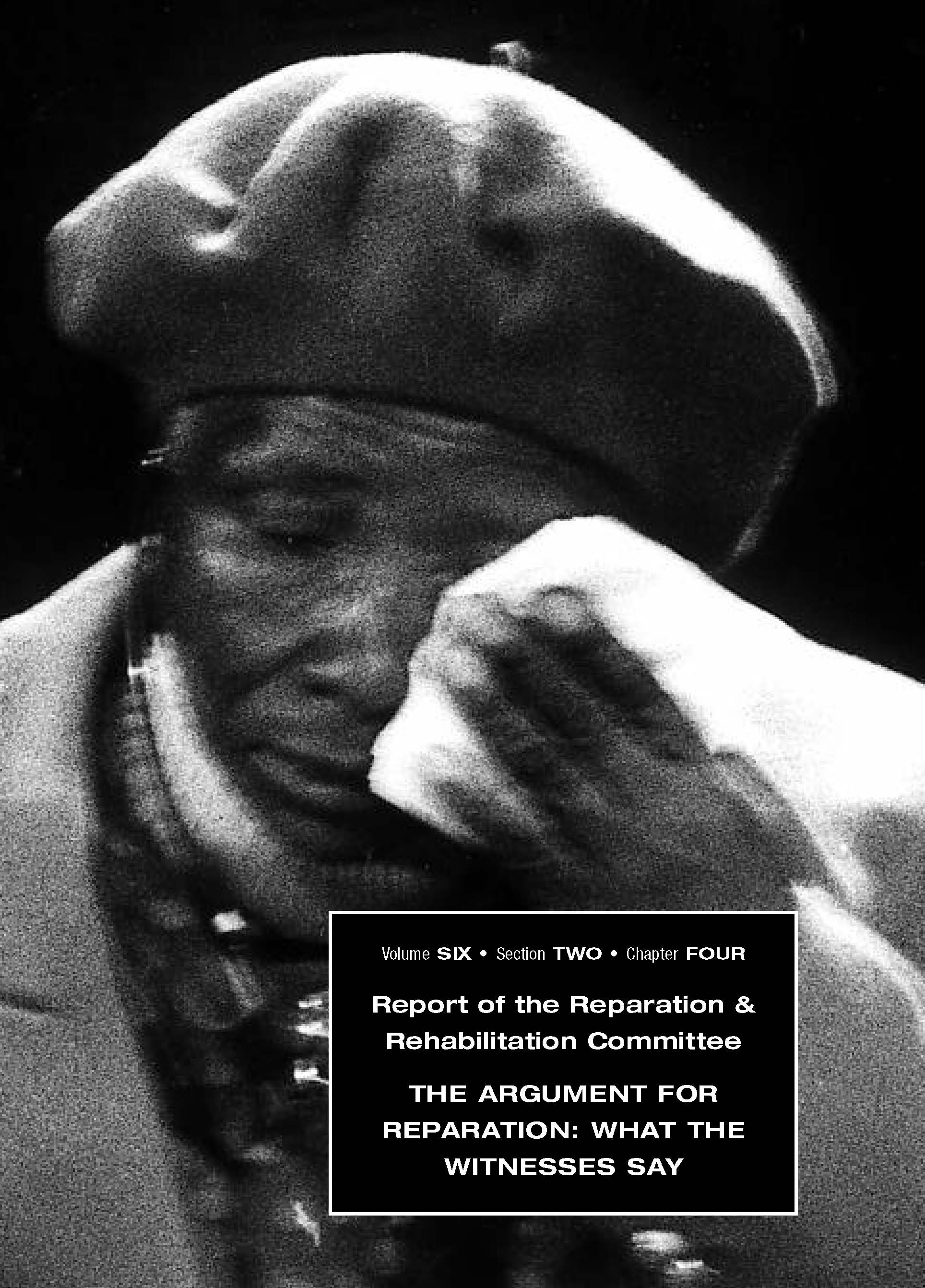
The Argument for Reparation: What the Witnesses say
-
Any broad process such as that undertaken by the Truth and Reconciliation Commission (the Commission) must necessarily summarise and generalise vast amounts of information to allow for presentation in a useful and accessible format. Yet, as we are all so acutely aware, behind each statistic lies a unique human s t o r y. It is the essence of this experience that the following section seeks to c a p t u re.
-
The stories below have not been chosen because they re p resent specific categories of the consequences of human rights violations and the issues they raise for reparation and rehabilitation. They are not and cannot be re p re s e n t a t i v e . They simply try to offer a context, a way to bring us back to what sometimes risks being obscured in the process of amassing and interpreting so vast a body of material. In so doing, they provide an opportunity to remember why we began this long and difficult journey into our past … a chance to hear once again the voices of some of those who spoke to us along the way.
THE STORY OF THE MZELEMU FA M I LY
-
On 2 April 1994, members of the Inkatha Freedom Party (IFP) attacked the Mzelemu family home at Port Shepstone. On that day, Ndukuzempi William Mzelemu lost almost his entire family: his 84-year-old mother, Cekise, his first wife Doris and seven of his daughters, Gugu, Hlengiwe, Joyce, Khululekile, Lindiwe, Phelelisile and Phindile, aged between five months and 18 years. His second wife, Ntombifuthi Mildred Mzelemu, survived but was injured, shot and stabbed. The reason for the attack was simply his son’s alleged involvement with the African National Congress (ANC).
-
On that fateful day, Mr Mzelemu heard a terrible knocking at his front door. He refused to open up but his attackers persisted, threatening to shoot if he refused to open up. Jumping out of the window, he ran to get help, with his attackers in hot pursuit.
-
Mr Mzelemu managed to evade the men and eventually got help from the c h i e f’s son. Together they went to the police station and arranged for members
-
of the security forces to accompany them to his homestead. On the way, Mr Mzelemu saw his second wife, Ntombifuthi, crawling towards the main ro a d , carrying their five-month-old baby girl on her back. When he saw that his wife had been stabbed and was covered with blood, he asked the soldiers to stop and help him take her to hospital. At the hospital, he was shocked to discover that the baby had also been stabbed. She was certified dead on arrival.
-
When Mr Mzelemu re t u rned home, he found that eight members of his family had been hacked to death.
-
Mr Mzelemu was employed at the time of the attack. The area in which he lived was tense due to violent political conflict and people were afraid to help him arrange for the funeral of his family members. As a result, he had to make the burial arrangements himself and had little time to mourn or grieve.
-
After the funerals, Mr Mzelemu’s life became unbearable. He received constant t h reats from the people who had killed his family and was forced to resign fro m his job because of repeated anonymous telephone calls at work.
-
He finally fled the area to escape those who threatened to hunt him down. As a result, he was separated from the remaining members of his family, whom he was forced to leave behind in Port Shepstone. Then his daughter Elizabeth dis-a p p e a red during violence in the area and he lost contact with her as well. Although he reported her disappearance to the police, to this day he has not h e a rd from them. He has no idea where she is or whether she is still alive. This is a source of great concern to him.
-
Although he reported the killings to the police station, he was later told that the docket had gone missing. The police also tried to persuade him not to pro c e e d with the case, telling him that he would get nothing out of pursuing the matter but his own death. He was told that people holding high positions in the ‘pre v i o u s system’ were involved.
-
Mr Mzelemu settled in KwaMashu where he now lives with his married son. Both he and his wife are unemployed. In an interview with the Commission5 2, Mr Mzelemu said that he always carries a picture of his children in his mind and that he does not know how he survived the ordeal. He raised a number of concern s ,
52 Interview conducted with deponent by the Commission, 2 0 0 0 .
including the fact that he cannot forget the brutal killing of his family members or his missing daughter and that his wife is finding it difficult to adjust to township life, which she finds very violent. He made the following re q u e s t s :
|
a |
He would appreciate it if the Commission could help him to find a place of |
|
his own. |
|
b |
He would like assistance in finding his daughter Elizabeth, who is still missing. |
|
c |
The family is facing a terrible financial situation. |
|
d |
His childre n ’s educational needs need to be addre s s e d . |
|
e |
The experiences have been very traumatic for the entire family and they |
|
would appreciate some form of counselling. |
THE DEATH OF GEORGE AND LINDY PHAHLE AND JOSEPH MALAZA
12. This is the story Hilda Phahle told the Commission about the South African Defence Force (SADF) raid on Gaborone in 1985:5 3
I will start from ‘is hulle dood, morsdood? ’5 4 These are the words of the SADF members after killing our children on lot 15717 in Gaborone, Botswana, on that fateful night of June 13/14 1985.
It all began on 10 December 1976, when police from John Vorster Square raided and ransacked our home. They did not have the decency to tell us what they were looking for. Their language was spiced with the violence of words. Yes, this was the beginning of the rest of our beloved son George’s life, which ended when he, his wife Lindy née Malaza and her cousin Joseph Malaza were brutally massacre d in their home by the SADF in Botswana in Gaborone on the 14th of June 1985.
Our children fled this oppression of this country. They went into exile, fighting for their rights, for the land of their birth, the land of their forefathers. They were tortured beyond reason and fled. The enemy followed them and brutally massacred them, ‘m o r s d o o d’, (stone-dead) – yes, ‘m o r s d o o d’ .
It is now time and it is their right to rest in peace on the soil where they were b o rn, the soil they died for. It is time they were brought home to be buried w h e re we can visit them at our convenience.
The victims, George Phahle, our son, who tried to make ends meet by running a transport business on a hired permit in Botswana; Lindi, BA Social Sciences, his wife, employed as a social worker by the Botswana government; Joseph Malaza,
53 Evidence of H Phahle to the HRV hearing in A l e x a n d r a , 30 October 1996. 54 ‘Are they dead, s t o n e - d e a d ? ’
V O L U M E 6 S E C T I O N 2 C H A P T E R 4 P A G E 1 2 2
L i n d i ’s cousin who was just visiting there for the night. Survivor: Levi, our younger son who lived to tell the story and was adversely affected.
He tells the gruesome story of how the SADF arrived swearing and behaving like
people well-drugged and drunk, ordering George to open the door. The door was
blown open. Instead of opening, George and Lindi ran into his bedroom, locked
the door, and pushed his portable piano against it. Lindi threw herself face down in
a corner. George fell over her as a sign of protection. There was nothing impossible
with these murderers. They blew the door open, pushed it and the piano fell
against Levi’s bed under which he was hiding. God spared him to tell the story.
THE STORY OF MRS ELSIE LIZIWE GISHI
13. On 26 December 1976, Mrs Gishi was shot in Nyanga, Cape Town, during a conflict involving riot police, hostel-dwellers and township residents. On the same day, her children went out to look for her husband, who they feared had been attacked by the hostel-dwellers. Mrs Gishi explained:5 5
When my children got to the house, they found their father full of blood, the house on fire, and he was dead. The hostel-dwellers had killed him, and threw him outside. They had cut his ears. And then my children called people. God gave them s t rength. This time my son who was 16 years old was put inside a van with his dead f a t h e r, to save him. The men decided that at least the son should survive so that the father has someone remaining to take his place. This is how they explained to me when I came back from hospital. The vans were transporting people; childre n w e re dead; houses burning, and I was taken to Tygerberg Hospital.
14. Mrs Gishi’s husband died in hospital and she describes herself as ‘never physically well’ since the shooting. It proved impossible to remove some of the bullets in her body due to the risk of damaging vital organs. Mrs Gishi complained of paralysis on the one side of her body and said she was unable to undertake various everyday tasks like buttoning her clothes due to brain damage. She has to take sleeping pills and said she would end up in ‘Pinelands’ ( Va l k e n b e rg Hospital, a psychiatric hospital) were she not to do so. She described what happened when she tried to manage without the pills:
Once I did not take the sleeping pills. I was tired of taking pills; my body is always sore because of all this medication. Just when I was beginning to fall
55 Interview conducted with deponent by the Commission, 2 0 0 0 .
asleep, I experienced a sharp pain, I woke up; the pain moved to the head, I felt like my head was on fire. I screamed and then collapsed. My children came and found me unconscious. The first time was ‘77, my children could not see any f i re and they called the neighbours, who also came and said they couldn’t see anything. So since ‘77 I have been taking these pills.
-
Mrs Gishi’s physical incapacity, emotional difficulties and ongoing financial struggles form the backdrop of everyday life for the family. ‘I lost my health, my life, my husband and my furn i t u re, and I was a worker’, she said.
-
Mrs Gishi has five children. Her only son was stabbed at a party some time ago and he lost the use of one of his hands. Her youngest daughter has experienced emotional difficulties and abuses alcohol as a result. Although it could be arg u e d that these problems with her son and youngest daughter cannot be directly linked to the events of 1976, there is little doubt that the circumstances in which she was shot and partially disabled, and the manner in which she was traumatically widowed and had her home burnt down, impacted on her childre n ’s experiences while growing up.
-
Mrs Gishi’s son, Bonisile, who accompanied his dying father to hospital, must have been affected by this event and his mother’s shooting that same day. The daughters in the family must also have been affected by these tragic events. Any family undergoing these experiences and the ongoing difficulties they cause needs both practical and emotional re s o u rces to help them deal with these issues over time. Mrs Gishi’s ability to provide or seek out these re s o u rces was traumatically interrupted many years ago and her own mental and physical condition has become a burden for herself and her family over the years.
-
Mrs Gishi reported that she spent the R2000 given to her after she testified b e f o re the Commission mainly on furn i t u re. She asked, however: ‘Where is my h u s b a n d ’s share? What is R2000?’ She has, however, had some acknowledgment of what happened to her and her family, as is the case with most of those who received a financial grant of interim reparation.
-
Mrs Gishi’s case raises the recurring question as to whether interim reparation is suff i c i e n t .
THE STORY OF MRS LEONILLA TENZA
-
Early in Mrs Te n z a ’s interview5 6 she said, ‘Hmm! I have been really traumatised in life.’ Born in 1932, she described being bitten by police dogs while ‘we were toyi-toying for our freedom’. She said that she fell while running away fro m police dogs and consequently lost a child. At the time, Chief Mangosuthu Buthelezi was still a member of the ANC. Subsequently, when the ANC was banned, ‘we all joined IFP-Inkatha’. Her brother divorced his first wife when their infant son, Eugene Xolisani Tenza, was seven months old, and Mrs Te n z a took the child in and raised him. When her nephew grew up, there were few employment opportunities and she recommended that he join the KwaZulu Police (KZP).
-
On 13 June 1989, during a period of great tension between the ANC and IFP in KwaZulu/Natal, Xolisani was murd e red. This incident formed the basis of Mrs Te n z a ’s testimony to the Commission.
-
A c c o rding to Mrs Tenza, she was made to witness her already injured nephew being axed to death. For some time she was also in danger and had to re m a i n on the run until a community member finally arranged a meeting at which ANC ‘comrades’ were persuaded not to kill her and to allow her to re t u rn home.
-
Among other difficulties, Mrs Tenza now had sole responsibility for her slain n e p h e w ’s two-year-old child. She claimed that her own children were not killed because, ‘they were ANC members to avoid being killed’. Her business as an indigenous healer or inyanga was severely affected, as clients were afraid to consult her because of her alleged political leanings. She has subsequently lost a daughter to AIDS, and this daughter left four children ‘of whom I do not know their fathers’. One of these grandchildren is apparently mentally handicapped, and is in Grade I at the age of fourteen. One of her sons also died of a stroke ‘while they were t o y i - t o y i n g’. Another child was laid off from work for reasons she did not specify.
-
C u r re n t l y, Mrs Tenza is struggling to support her various dependants. She feels emotionally unable to continue her i n y a n g a practice and is helping the health authority with health education issues, specifically in relation to HIV/AIDS. She says that she has a heart condition and must take medication for this. Her participation in the local health forum has been compromised by her health:
56 Interview conducted with deponent by the Commission, 2 0 0 0 .
They called me recently for a Forum since I have not been able to attend them
because I was sick for a long time last year. I underwent an operation because
my intestines were burst due to my low blood flow. The organisers of these
Forums were surprised of my behaviour because we were working well. They
w e re the ones who re f e r red me to the hospital. My behaviour was so odd: I
used to have outbursts and did not wait for my turn to talk, and confabulated
when asked questions. I did not know what was happening in my head and
these people came to my house to beg me to come back to the Forum. I then
got better because I used to cry every day before .
-
At the outset of the interview, Mrs Tenza seemed robust and full of humour. As she began to relate her story, she became tearful and deeply upset. Although she claimed to be ‘better’ than in the previous year (1999), her distress was very a p p a rent.
-
As we have seen with other cases, the particular event Mrs Tenza reported to the Commission was little more than a punctuation mark in a life of ongoing difficulties. Both she and her family made political decisions at times influenced at least as much by attempts to survive violence and poverty as by ideological persuasions. The tone throughout is of a long struggle to eke out a meagre existence in a violent world. Mrs Te n z a ’s life story paints a vivid picture of the convoluted political history of KwaZulu/Natal and the human consequences. The awful experience of seeing her nephew murd e red in front of her is just one example of a broader tragedy.
-
It is very difficult to separate out the complex mixture of physical and emotional complaints and distress suff e red by Mrs Tenza. The distinction between mind and body that remains intrinsic to much of western biomedicine does not make any sense to her. She does not experience physical and emotional sensations s e p a r a t e l y.
-
Mrs Te n z a ’s experience points to important issues to be considered when planning services. One of the most significant is that commonly held distinctions between the physical and the emotional may not apply to all those who need assistance. Other distinctions – for example, between financial, educational, and emotional needs – may also prove problematic. Emotional issues can play a decisive role in the extent to which a person is able to learn or earn a living; c o n v e r s e l y, success or failure in learning impacts not only on economic well being, but also on emotions.
‘THIS IS MY FATHER AND LOOK WHAT THEY HAVE DONE TO HIM’: THE STORY OF SERGEANT RICHARD MOTHASI
-
R i c h a rd Mothasi was a police sergeant based at the Hammanskraal Police College. An assault by a white fellow officer left him with a burst eardrum. After he had laid a charge of assault, several unsuccessful efforts were made to pre s s u re him into withdrawing charges. On 30 November 1987, operatives of the Northern Transvaal Security Branch shot Sergeant Mothasi dead, allegedly at the re q u e s t of the then Divisional Commissioner of Police in the Northern Transvaal. His wife, Mrs Busisiwe Irene Mothasi, was also killed in the incident.
-
Some of those responsible for the killing applied for amnesty and testified that they had been told that Sergeant Mothasi was suspected of having made contact with the ANC.
3 1 . Mrs Mothasi’s mother, Mrs Gloria Hlabangane, told the Amnesty Committee (the Committee) of the circumstances surrounding the deaths of her daughter and s o n - i n - l a w :5 7
I received a telephone call in the morning as I was just preparing myself to go to town, and they said I should go to Hammanskraal … And I started to panic because at the time I knew that something had happened … I sat down and I begged [to be told] what had happened so that I may be able to gather enough courage to face the truth. Then [I heard] that my son-in-law had died as well as I rene had died.
We went to Ire n e ’s home … I got out of the car … When I got out of the car
t h e re was a hearse, and when I went into the kitchen, I came across somebody
pushing a stretcher and I had a look. I saw that it was my daughter, Irene, and I
d i s c o v e red that my daughter had died and she had one wound on the fore h e a d .
And I left her because I realised that she had died. I went into the dining room
… When I got there I discovered that Mothasi was laying in a pool of blood. And
he had also been shot. And the spent cartridges were on the floor, his brains were
also splattered, as well as certain pieces of the skull were on the floor, scattere d
all over the place and I looked at his ear, something whitish was coming out of
his ears – I don’t know whether it was his brains – and he was also dead.
And from there I ran. I went into the bedroom. That is their son’s bedroom, or their child’s bedroom. I looked for the child, but I couldn’t find the child. I
57 Evidence by G Hlabangane at a hearing before the Committee, P r e t o r i a , 5 March 1997.
looked in all the other rooms without any success, and I started getting very
confused at this stage because I didn’t know where the child was. And when I
went outside, I heard – I could feel somebody grabbing me and it was the child.
I took the child … He was five years old. I took the child. I lifted [him] to my
chest and the parents were taken in the hearse…
32. Asked where the child had been during the murders, Mrs Hlabangane testified:
When I asked my neighbours, they told me that the child was inside the house
at that time, but nobody knows as to how he survived, because he escaped
unscathed, but they heard the child screaming throughout the night asking for
help, saying ‘help me, help me’. He realised that something was happening,
probably he hid somewhere, but people were woken up by the screams of the
child inside the house. And my next-door neighbour came into the house in the
m o rning to fetch the child and they stayed with the child … He stayed with the
corpses of his parents and he was running from pillar to post trying to wake his
p a rents up, but there was no help coming at that particular moment.
33. While still at the house, three policemen arrived. Mrs Hlabangane thought that they had come to express sympathy about a fellow colleague’s death. Instead they demanded Sergeant Mothasi’s uniform. After removing the insignia, they t h rew the uniform back at her, telling her to give it to her ‘old man’. One of them, a white police off i c e r, then brandished a gun:
Do I know what a gun is used for … do you see what the gun has done to Mothasi and his wife. He said ‘if you talk too much, this is what you get’ and at the time he was pointing the gun at my fore h e a d .
34. Since the death of Richard and Busisiwe Mothasi, Mrs Hlabangane and her husband, a pensioner, have cared for their grandson. They receive R500 for child maintenance from Richard Mothasi’s pension, so they are able to pay for transport, groceries and schooling. However, her grandson re q u i res ongoing psychological support:
My grandson didn’t care throughout, he didn’t show any signs of being disturbed. But when he grew up, there were certain signs, even when he gets a newspaper w h e re there is something about a person who has died, he always came with the newspaper clipping and showed it to me. At some stage he got a Tribute magazine that had his father’s photo and he showed it to me and he said: ‘This is my father and look what they have done to him’. And since then he has been very disturbed, I had to seek medical attention for him … I ... take him to the clinic, but now I am facing a difficulty because where he is attending they want medical aid and I don’t have a medical aid and that is the problem that I am facing at this juncture .
35. While Mrs Hlabangane and her husband struggle to care for their grandson, t h re e58 of the perpetrators responsible for the killing received amnesty.
UNFINISHED BUSINESS: THE ‘NIETVERDIEND TEN’ AND S I YABULELA TWA B U
-
Whilst the Commission process did unearth a significant amount of new information with re g a rd to the causes, nature and extent of gross human rights violations, its processes inevitably also produced important information that could not be brought to an absolute conclusion or closure .
-
Perhaps the most painful scenario that arose from the limitations of the process was that the families of deceased victims learnt of the fate of their loved one(s), but did not learn of the whereabouts of their remains. One such example of this is the ‘Nietverdiend Ten’, the case of ten youths killed in a joint SADF and Security Police operation. The youths, aged between 14 and 19 years, had been ‘ recruited’ by Security Branch agent, Joe Mamasela, purporting to be an Umkhonto we Sizwe (MK) operative.
-
The youths left their Mamelodi homes on 26 June 1986, accompanied by Constable Mamasela, believing they were being taken to Botswana for military training. Instead, Mamasela drove them to a spot close to the Botswana bord e r w h e re a team of SADF Special Forces operatives surrounded them and injected them with a chemical substance, rendering them unconscious. A Special Forc e s operative then drove the vehicle towards an embankment, leapt out and left the vehicle to careen into a tree where it burst into flames, killing all of them.
-
The families of these youths spent ten years in ignorance of their childre n ’s fate. Many waited eagerly for their homecoming in the early 1990s when most exiles w e re re t u rning to the country. Only in 1996, following investigations by a special unit set up by the Attorney-General, did the families learn that their children were dead. The circumstances surrounding their death remained sketchy, however, and it was another three years before they were to witness the amnesty hearings of the perpetrators of these killings.
-
The families appealed for the remains of their children. Mrs Martha Makolane, the mother of 17-year-old Abraham, testified:5 9
58 A fourth person involved in the incident, Constable Joe Mamasela, did not apply for amnesty.
I don’t have the [reconciliation] as they have taken them from my place to the place where they have killed them. I want them to go and fetch them where they’ve left them to bring them home so that we will be able to bury them p e a c e f u l l y. Yes, we want those bodies as they have taken them from Mamelodi. They have got to go back and fetch them from that place and bring them back to Mamelodi so that we will be able to bury them.
41. Mrs Phiri, the mother of 21-year-old Thomas, testified6 0:
Let them tell us the full story so that we can – we are deeply hurt. If they tell the
s t o ry, we will be okay. We want to know where these children were buried
because we were never told the truth of where they were buried.
I want to enquire from the killers: yes, they told us that they killed them, they told us that they injected them with drugs and they are buried, but I want them to know that their graves are open and even in heaven they will not get forgiveness at all because they killed minor children. Had these children killed people b e f o re, we would have understood that, yes, it was their turn to be killed. But I want to tell them today that they will never get forgiveness from God at all. Their graves are waiting for them, waiting open.
-
Further investigations revealed that the youths had been buried in pauper’s graves in Winterveld cemetery. After three visits to the cemetery, the families made contact with two workers who re m e m b e red burying the remains. They w e re, however, unable to locate the exact sites.
-
The most recent attempt to exhume the remains was carried out on 3 March 2001. However, the areas indicated by the cemetery staff did not produce anything. Fourteen years after the youths disappeared, the search has now been re d u c e d to an area the size of half a football field – seemingly so near, yet so far away f rom the sort of ceremony that the families need traditionally, culturally and emotionally for closure. All those who applied for amnesty for this incident have had their applications granted.
59 Evidence heard at hearing of the Committee in Jo h a n n e s b u rg in the application of J Cronje and others, 2 1 – 3 1 October 1996.
60 Evidence heard at hearing of the Committee in Jo h a n n e s b u rg in the application of J Cronje and others, 2 1 – 3 1 October 1996.
V O L U M E 6 S E C T I O N 2 C H A P T E R 4 P A G E 1 3 0
THE CASE OF SIYABULELA TWA B U
44. While the families of the ‘Nietverdiend Ten’ and others still search for the remains of their children who died inside South Africa, other families live with the pain of knowing their children are buried in foreign lands. Siyabulela Tw a b u was 19 years old when he left his Transkei home and went into exile. His mother told the Commission how she learnt of his fate:6 1
Time and time again the police would come. Sometimes I would be at work: I
am a teacher. I requested politely that they should not come to my workplace
because the people from the village are against the police. They were going to
be under the impression that I was liaising with the police. After a while I was
called; there was a meeting, a teachers’ meeting and I was called outside. Mr
Sifuma was outside. I got into the car, he drove a bit, gave me a newspaper.
T h e re was an article about Siyabulela’s death – apparently he had been shot.
45. Siyabulela was one of six Azanian Peoples’ Liberation Army (APLA) members killed in a shoot-out with Transkei and Lesotho security forces at Quacha’s Nek on the Transkei–Lesotho border in March 1985. Their bodies were found several days later, decomposing in a forest. Siyabulela was buried in a grave in Lesotho, without his family being pre s e n t :
We went to the funeral. We got there; he was already buried. Because we were travelling on the gravel road, we were trying to escape from the police. When we got to Maseru, it was too late. The police took us to where he was staying. I came back from the funeral and I continued with my life.
46. Mrs Twabu made the following plea to the Commission:
I request that my child’s body be exhumed from Lesotho because he is buried next to a river. The riverbanks are quite big and it is not safe. Could the Commission help me with medical aid, I am mentally ill, I am also – my heart also is ailing. His father died in 1983, then my son in 1985. After that, I – my health started deteriorating.
-
These scenarios illustrate the kind of unfinished business raised at the Commission that will be impossible to follow through without the necessary re s o u rces and skills.
-
In many cases, the mere fact that information emerged at the Commission did not lead to a quick and easy solution. In too many instances, this resulted in a p rotracted and painful search that, for many, may never reach conclusion.
61 Evidence by Mrs N Twabu at HRC hearing, L u s i k i s i k i , 26 March 1997.
THE STORY OF MAGISENG ABRAM MOTHUPHI
49. Mr Magiseng Mothuphi was 21 years old when he, his bro t h e r, his sister and seven others stopped at a roadblock between Krugersdorp and Ventersdorp in 1993. This was not a police roadblock but was manned by a group of heavily armed Afrikaner Weerstandsbeweging (AWB) members. The occupants were f o rced out of the vehicle:
[They] took us out of the car and they said we should raise up our hands. Then they searched us. After they searched us, they showed us where we should stay. We sat down in a line. Whilst we were sitting there in a line, they were asking us questions as to … where do we come from and where do we go, about our work situations, as to whether are we employed or not. At the time when we w e re questioned, they were hitting us with the gun butts on the head. I was bleeding at the time with my nose. Then I was bending my head …
[After] that then they told us that we were members of the ANC. Simon Nkompone said that we are not members of the ANC and we don’t know anything about the ANC. Again they started to hit us [and] told us that we are not telling them the truth. …
[Then] they were conniving amongst themselves. After that they came back and
then I heard a gun shot; I didn’t know what happened. Then I woke up. I was
bleeding and when I looked at myself on the mirror of the car, I was bleeding
and injured. Next to me was Simon Nkompone. Then the young [girl] who is my
[niece], was cry i n g. 6 2
50. Mr Mothuphi’s brother and sister and two other passengers were killed in the shooting and his nose was destroyed. For seven years, the young man covere d the hole in his face with an ‘Elastoplast’ bandage. In 1998, Mr Mothuphi was invited to attend the amnesty hearing of the AWB members involved in this incident. At the time of the hearing, Mr Mothuphi had not been declared a victim of a gross violation of human rights by the Commission, as he had not made a statement to the Committee on Human Rights Violations (HRV C ) .
62 Evidence by M Mothupi heard at hearing of the Committee in the amnesty application of AWB members for the ‘Rodora Crossing’ incident in Jo h a n n e s b u rg , 12 June 1998.
V O L U M E 6 S E C T I O N 2 C H A P T E R 4 P A G E 1 3 2
-
The sight of Mr Mothuphi in the television coverage of the hearing sparked the i n t e rest of Greg Bass, head of the department of dental technology at Natal Technikon, which specialises in the construction of facial prostheses. Mr Bass contacted the Reparation and Rehabilitation Committee (RRC) to offer assistance. He said that his department had funds for charity work and would be in a position to pay for the treatment. This proactive response from the doctor was unusual, compared with the usual passive witnessing of victim testimony that characterised the attitude of the majority of viewers.
-
A lengthy wait ensued until the Committee had finalised the matter and re f e r red Mr Mothuphi to the RRC as a victim, whereupon he became eligible for reparation. T h e re a f t e r, the RRC arranged for the Technikon to make a prosthetic nose for Mr Mothuphi. His transport to Durban was donated by Transnet and he used his interim reparation grant to pay for his stay while he was having tre a t m e n t .
-
After having the prosthetic nose fitted, Mr Mothuphi was asked if his life had changed:
My life has changed very much. Before this operation I was afraid even to go to the shops because many people looked at me and stared. Since I got this nose, I’m fre e. I want to go somewhere I can study so that I can get a job but it’s hard because I have no money. After the accident [violation], I lost my girlfriend because of my face; but since the treatment I have found a new girlfriend, I’m very, very happy now. 6 3
-
Months after the medical pro c e d u re, Mr Mothuphi approached the Commission with a request that may be seen as a symbolic and instructive metaphor. He telephoned the Commission to ask for the contact details of the Technikon as he had run out of the special surgical glue needed to attach the prosthetic nose to his face. Although undoubtedly an oversight, such a situation highlights the crucial importance of the sustainability of any reparation intervention and the potential for counter-productive and traumatic side effects from quick fix solutions. This example also demonstrates clearly that one intervention, however significant, is insufficient to address the wide-ranging consequences of a particular violation.
-
At the same time, unique as it is in terms of the usual experiences of victims and the Commission, Mr Mothupi’s story is important because it illustrates the potential benefit that interventions from a number of sectors can have. It also shows how the amnesty process identified victims who would not otherwise have entered into the Commission pro c e s s .
63 From communication with the RRC.
‘LEFTOVERS FROM THE STRUGGLE’: THE STORY OF MR XOLILE D YA B O O I
-
In 1987, Mr Xolile Dyabooi was detained by the Bophuthatswana Police. He was t o r t u red in Mmabatho and held in solitary confinement in Brandvlei prison, b e f o re being convicted of terrorism and jailed for five years. He was released as part of the indemnity process in December 1990.
-
In Mr Dyabooi’s view, reconciliation can only effectively be achieved when those who have suff e red are given an opportunity to participate in rebuilding society. As a person who fought on the side of what became the present govern m e n t , he told the Commission:6 4
What I am saying is that we contributed a lot to the struggle: our contribution can never be necessarily only paid on money, there are many things. But now after all these things I feel the other people tend to forget our role. There are those who might benefit from our victories. So now feel that we are people who a re leftovers from the struggle.
Because we were supposed to be given an opportunity, like of using the skills we got from our times in the struggles, in terms of building reconstruction, I mean in terms of building reconciliation, because I don’t believe reconciliation can only come through Mandela or Thabo Mbeki’s speeches. I believe that people on the ground, who experienced those things, must be able to be given opportunities, like opportunities in terms of work, bursaries and all those things. But I strongly believe that the contribution we can be, like we need to be on the ground, and all that, to do something. But now our skills instead of being used, they are wasted, you see. Because after the whole thing you don’t feel comfortable in this situation, ja.
I am still suffering. I’m still at my home. My life is in ruins. I don’t have hope for t o m o r r o w. Maybe I will survive. I don’t know. I am just a human that goes up and down like a zombie. Although there are some sung heroes who are there. So I believe that we are unsung heroes. We contributed to the struggle, then we w e re banned until the new order came and even the new order banned us. D o n ’t talk, maybe someone from above will come and address these things. We waited until now.
64 Interview conducted with deponent by the Commission, 2 0 0 0 .
58. Mr Dyabooi expressed anger at the present government and at the Commission, which he sees as working closely with the govern m e n t :
Ja, when I went to the TRC I hoped for better life. I thought I would get better life in terms of – in terms of – like I asked for education, I asked for – I mean, how can I say now – I asked for accommodation and whatsoever. Although those people promised that they will consider my request, I waited until now, nothing has happened. I just hoped each and every month and years. I waited and waited but today, now, I won’t wait.
In the beginning the government promised to give us reparation, but at the end the g o v e rnment now is trying to play hide and seek. They don’t give us a opportunity to express our views. They don’t call us into their commissions, to present our ideas or our feelings about the whole thing – they just sum up, and go and take decisions on their own.
So there f o re I am saying, there can’t be reconciliation without taking those people who were victims into their board.
CONSEQUENCES OF GROSS VIOLATIONS OF HUMAN RIGHTS: D I S C U S S I O N
-
It must be stressed once again here that the stories presented in this section a re not re p resentative either in terms of violations or the experiences of victims. Each of these stories has its own individuality and texture, and this must be born e in mind when considering the special needs and circumstances of each victim.
-
What is, of course, re p resentative about these stories is that they are about
o rdinary men and women whose lives were irrevocably changed by the violations they suff e red during the course of political conflict.
-
Some of the arguments politicians have raised in response to calls to implement the recommendations of the Commission’s RRC have caused concern. They make the point that the majority of victims were political activists who, in one way or a n o t h e r, made a conscious decision to engage in a political struggle against apartheid. The argument is often expressed thus: ‘we were not in the struggle for money’. While the Commission understands the grounds upon which this statement is made, in terms of international human rights law on reparations and rehabilitation even political activists who decided to become involved in the struggle against apartheid should be compensated if they became casualties of the conflict.
-
The Reparation and Rehabilitation policy raises far- reaching and complex questions concerning individuals who have been victims of gross violations of human rights. How can we assess the impact of an abuse of human rights on the life of any one individual? Is it possible to separate that abuse from other aspects of a person’s life? Is it possible to make an accurate assessment of the impact without understanding the full context of that person’s life? How can we conclude what a person’s life would have been like had the violation not occurred?
-
The simplest model (and one that is commonly used) is of a single negative event having a single negative consequence for the person involved. It would be convenient if we could simply draw up a list of negative things that happen to people, assign a weighting to them and from there determine accurately the impact of event X on person Y. This would certainly simplify the issues and administration of reparations and rehabilitation.
-
H o w e v e r, in many cases, people affected by what are defined as gross violations of human rights have been living lives in which other, ongoing stre s s o r s have played their part. These stressors include living with poverty, discrimination, lack of access to the re s o u rces the country has to offer and the experiences of humiliation and disrespect that many black South Africans have borne for generations. More o v e r, oppression, humiliation and racism have serious consequences not only for individuals but for the social fabric as well. Thus, although the Commission is bound by its mandate to consider only certain kinds of violations, it is necessary to describe the context within which these violations took place.
-
This leads to a further question to be considered: how do we understand the consequences of social injustice and human rights violations for individuals, for their families and for communities?
-
Compounding the matter even further is the fact that the effects of trauma appear to be felt by succeeding generations. For example, studies on childre n and grandchildren of survivors of the Holocaust in Europe in the middle of the twentieth century show clearly that these now-distant events continue to impact on the course of people’s lives, their patterns of attachment and the quality of their relationships. Arguments about financial compensation from that now-distant calamity also continue unabated.
-
Thus, it is not only the case that events occur in context, as we have already mentioned, but that the consequences of events impact on the way people
-
continue with their lives, their relationships, their child-rearing practices and those of their children and grandchildren for decades after the traumatic event.
-
Another complexity in understanding human rights violations lies in the fact that the same people have, in diff e rent events, been both victims and perpetrators. One reasonably common consequence of abuse is that abused people have a g reater likelihood of becoming perpetrators of abuse. Many people who have perpetrated what are defined as gross violations of human rights have t h e m s e l v es been affected by abuse, poverty and discrimination.
-
F u r t h e r m o re, the consequences of human rights abuse and political oppression may at times cross the boundaries of public and private life. For example, a person who has been abused and humiliated in the context of a political struggle may be more likely to perpetrate abuse and humiliation in the context of family life. It has also been well established in many contexts that people who have been oppressed may be at risk of emulating their oppressors – and of taking on the oppressor role in the future. Active intervention in this cycle is often necessary in order to break it.
-
White South Africans who were protected by the state bear scars of a diff e rent kind. Although there is no question that being a target of discrimination generally has far more serious consequences than being a beneficiary of it, social injustice has consequences for all who live in the society. If the Commission is to fulfil its role of contributing to the rehabilitation not only of individuals but of the nation as a whole, South Africa must look seriously at the social consequences of allowing the beneficiaries of an unjust system to re p roduce discrimination at a cost to themselves and future generations. A nation that turns its back on these social realities places itself at serious risk of an ongoing cycle of injustice and violence.
R E PA R ATIONS AS A VEHICLE FOR RECONCILIATION AND HEALING
7 1 . T h e re are examples worldwide of noble agreements aimed at resolving bloody conflicts that have proved unsustainable beyond the lifetimes of the peacemakers. Talks about reconciliation that fails to emphasise justice for victims seem doomed to fail in their promise of national unity and reconciliation. This is why calls for reparation and rehabilitation urge South Africans to dismantle the ‘conspiracy of silence’ that often characterises the ongoing experience of victims and surv i v o r s of violations of gross human rights.
-
Dr Yael Danieli, director of the Group Project for Holocaust Survivors and their C h i l d ren and director of the Centre for Rehabilitation of To r t u re Victims in New York, suggests that silence is the most common way society responds to the survivors of trauma. Because most people find trauma overwhelming, they choose to avoid dealing with it. Unfortunately such avoidance further isolates the individual or the community, entrenching the feeling of alienation and vulnerability often experienced by those who have been in the hands of torturers and killers. The silence may leave the ‘suff e rers’ with no option but to re p ress their pain, there b y delaying the desired complex healing process from being initiated.
-
The Commission’s Final Report discussed in some detail the enormous importance of reconciliation as ‘a goal and a process’ of the Commission.6 5 I t highlighted the diff e rent levels at which reconciliation needs to take place in South Africa and the complexity of the links between them.
Many years ago, Albert Luthuli, the first South African recipient of the Nobel Peace Prize, articulated a vision of South Africa as ‘a home for all her sons and daughters’. This concept is implicit in the Interim Constitution. Thus, not only must we lay the foundation for a society in which physical needs will be met; we must also create a home for all South Africans. The road to reconciliation, t h e re f o re, means both material reconstruction and the restoration of dignity. It involves the re d ress of gross inequalities and the nurturing of respect for our common humanity. It entails sustainable growth and development in the spirit of u b u n t u … It implies wide-ranging structural and institutional transformation and the healing of broken human relationships. It demands guarantees that the past will not be repeated. It re q u i res restitution and the restoration of our humanity – as individuals, as communities and as a nation.6 6
74. The policy proposed by the RRC and described in the Final Report67 encompasses the spirit of this paragraph. Urgent interim reparation seeks to p rovide assistance for people in urgent need. Individual reparation grants seek to ‘transform abject poverty into modest security’.6 8 Symbolic reparation and legal and administrative measures seek to assist communities and individuals in commemorating the pains and victories of the past. Community re h a b i l i t a t i o n p rogrammes seek to establish community-based services in order to aid the
65 Volume One, Chapter Fi v e, p. 1 0 6 . 66 Volume One, Chapter Fi v e, p. 1 1 0 , para 26. 67 Volume Fi v e, Chapter Fi v e.
V O L U M E 6 S E C T I O N 2 C H A P T E R 4 P A G E 1 3 8
healing and recovery of individuals and communities. Institutional, legal and administrative reforms are designed to prevent the re c u r rence of human rights abuses.
75. Speaking at a series of workshops hosted by the Commission in Gauteng, KwaZulu-Natal and the We s t e rn Cape, Dr Danieli warned that failure to act will cause South Africans to pay for the legacy of political violence in the future . She proposed that healing and reparation in South Africa should be prioritised as a cornerstone for transformation beyond the life of the Commission, and should take place at individual as well as community (school, church, workplace) and national levels. In the words of Wole Soyinka:
As the world draws closer together – the expression ‘global village’ did not come into currency for no just cause – it seems only natural to examine the s c o resheet of relationships between converging communities. Where there has been inequity, especially of a singularly brutalizing kind, of a kind that robs one side of its most fundamental attribute – its humanity – it seems only appropriate that some form of atonement be made, in order to exorcise that past. Reparations, we repeat, serve as a cogent critique of history and thus a potent restraint on its repetition … It is not possible to ignore the example of the Jews and the obsessed commitment of survivors of the Holocaust, and their descendants, to recover both their material patrimony, and the humanity of which they w e re brutally deprived.
Back to Contents Page... go to page 14068 Volume One, Chapter Fi v e, p. 1 2 5